If you run (or plan to launch) an inflatable rental business in the U.S., choosing commercial-grade inflatables—and operating them correctly—is what protects customers and profits. This guide focuses on three things that matter most: safety/compliance, blower & power planning, and an inventory strategy that books out all season long.
1) Safety & compliance (non-negotiable)
In the U.S., manufacturers and operators look to ASTM F2374, the practice that covers the design, manufacture, operation, and maintenance of inflatable amusement devices. Make purchasing and SOP decisions that align with this framework and your manufacturer’s manual.
Field-tested basics you should never skip
-
Anchoring: Follow the manual exactly (stakes/ballast as specified). A CPSC safety bulletin stresses anchoring per manufacturer instructions and shows how anchor weight needs vary by device type.
- Active supervision: Assign trained attendants; control lines and rider flow; separate by age/size.
- Weather checks: Monitor wind and power conditions; deflate and secure when thresholds or site conditions aren’t safe.
- Clear labels: Keep rider-rules and capacity labels visible; train staff on setup/tear-down checklists.
2) Blower sizing & power planning
Commercial inflatables use continuous-air blowers. As a practical rule of thumb:
-
Small bounce houses (~12′×12′) often run on ~1 HP (check CFM on the spec sheet).
-
Larger houses/slides often need ~2 HP (sometimes multiple blowers).
-
Long obstacles/tall slides may require 2–3 HP or more than one unit.
Always verify each model’s required HP/CFM and number of blowers before event day; most commercial setups fall in the 1–3 HP range.
Power tips
-
Use dedicated, grounded circuits; avoid daisy-chaining.
-
Use outdoor-rated extension cords sized for run length and load.
-
Stage generators (if used) away from traffic and fueling hazards; match wattage to blower draw plus headroom.
3) Materials & construction that last
When you evaluate units, look beyond the graphics:
-
Vinyl & stitching: Commercial PVC with reinforced stitch patterns or heat-sealed seams at high-stress zones (entrances, slide lanes, step-walls, anchor D-rings).
-
Hardware: Robust zippers with hook-and-loop covers; plenty of D-rings positioned where the manual prescribes.
-
Serviceability: Replaceable wear covers (entrances/slide lanes) and accessible zipper/relief points make maintenance faster.
4) Site setup & anchoring (quick checklist)
-
Walk the site: level ground, clear of overhead lines and sharp objects.
-
Ground cover/tarp down; unroll and position the unit.
-
Connect blower(s) as specified; secure intake screens; route cords safely.
-
Anchor every point exactly as the manual shows (stakes or approved ballast).
-
Inflate, inspect seams/netting/entrances; place rules signage.
-
Brief attendants on rider limits, entry/exit, wind watch, and emergency deflation.
5) Inventory that actually books (what to buy first)
-
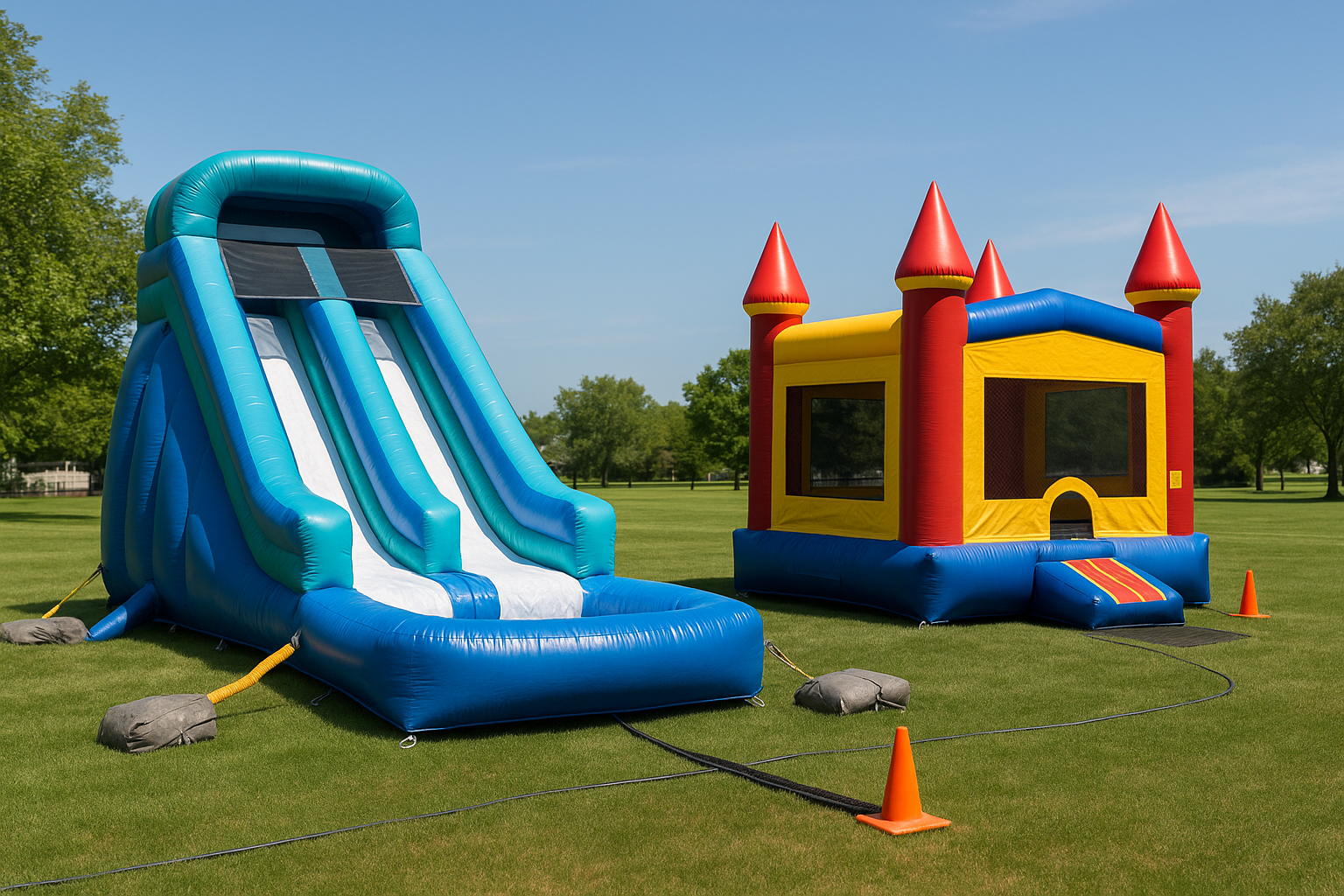
Water Slides: Summer all-stars with premium pricing and huge repeat demand.
-
Commercial Bounce Houses (Jumpers): Year-round staples that bundle well with concessions and small add-ons.
See our All Jumpers lineup. -
Wet/Dry Combos: High perceived value and flexible for parks, churches, and schools.
-
Obstacle Courses: Perfect for corporate, school, and community events thanks to high throughput.
Shop Obstacle Courses. -
Need inventory now? Check In-Stock for quick-ship units that can start earning this month.
6) Care & maintenance (protect your investment)
-
Clean & dry after every event. Moisture trapped inside causes mildew, seam issues, and odor.
-
Store bone-dry. Packing a unit wet can void coverage—this is a common warranty condition in the industry and in Tago’s Jump’s own terms. Tago's Jump
-
Rotate wear items. Entrance mats, slide covers, and step covers are consumables—replace on schedule to extend the unit’s life.
-
Log everything. Keep a simple service log (cleaning, repairs, vinyl patches, zipper replacements) to support warranty claims and resale value.
Mini-FAQ
What U.S. standard applies to commercial inflatables?
ASTM F2374, covering design, manufacture, operation, and maintenance. Use it alongside your manufacturer’s manual and local rules. ASTM International | ASTM
How many blowers/what size do I need?
It depends on the model. Many small houses run on ~1 HP; bigger slides or obstacles often need ~2 HP or multiple blowers. Always follow the spec sheet. Pogo Bounce House
What’s the biggest setup mistake to avoid?
Improper or incomplete anchoring. Follow the manual and use the right stakes/ballast for each anchor point; the CPSC emphasizes anchoring per manufacturer requirements. U.S. Consumer Product Safety Commission
Ready to build a lineup that books out?
Start with Water Slides, add a core of Jumpers, layer Wet/Dry Combos, and finish with Obstacle Courses—then browse In-Stock to fill immediate gaps. Our team can help you match blowers, plan power, and schedule freight.