Before you buy a commercial bounce house, you're really asking one question: how fast does it pay for itself? Unlike a consumer-grade inflatable bought for a backyard, a commercial unit is a revenue asset. Treated like one, it can return its purchase price in a single busy season. This guide walks through the actual math rental businesses use to evaluate a purchase.
The Only Formula That Matters
Every rental ROI decision comes down to three numbers:
- Unit cost — what you pay for the inflatable (one-time).
- Rental rate — what you charge per event (recurring).
- Bookings to break even — unit cost ÷ rental rate.
That last number is your finish line. Cross it, and every booking afterward is profit minus your operating costs.
A Realistic Example
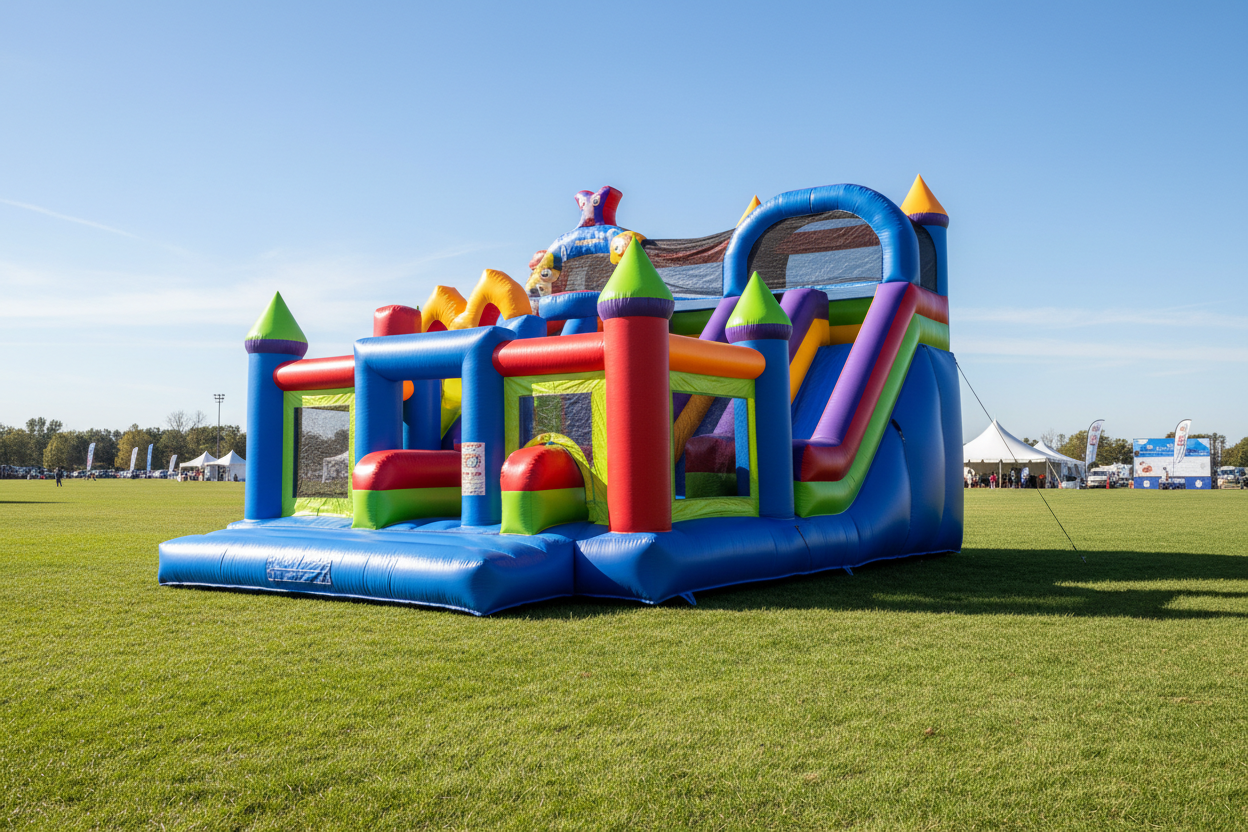
Say you buy a commercial wet/dry combo for $3,000 and rent it at $250 per day. Your break-even point is:
$3,000 ÷ $250 = 12 bookings
Twelve weekends. In most markets, a popular combo books most weekends from late spring through early fall — meaning the unit can pay for itself well inside its first season, then keep earning for years.
| Unit type | Typical cost | Avg. day rate | Bookings to break even |
|---|---|---|---|
| Standard bounce house | $1,800 | $175 | ~11 |
| Wet/dry combo | $3,000 | $250 | ~12 |
| Water slide | $4,500 | $350 | ~13 |
| Obstacle course | $6,000 | $450 | ~14 |
Figures are typical industry ranges for illustration. Your costs, rates, and demand will vary by market.
Why Day Rate Beats Unit Price
New buyers fixate on finding the cheapest inflatable. That's backwards. A unit that costs $1,000 more but commands a $75 higher day rate pays back the difference in roughly 13 bookings — and then out-earns the cheaper unit on every single booking for the rest of its life. The premium feature (a slide, a water option, a themed design) is what lets you charge more, and the day rate compounds. The purchase price is paid once.
The Highest-ROI Categories
- Wet/dry combos — bookable year-round (dry in cool months, wet in summer), so they're idle far less than single-purpose units.
- Water slides — premium summer day rates and strong repeat demand for parties and community events.
- Obstacle courses — higher ticket, and they win corporate, school, and church events that book at premium rates.
Costs to Factor In
Break-even isn't the whole story. Before you call a booking "pure profit," account for:
- Transport and fuel
- Setup/teardown labor
- Cleaning and routine maintenance
- Liability insurance
- Storage
These are real but modest against a $175–$450 day rate — which is exactly why the rental model works.
Commercial vs. Consumer: Don't Confuse the Two
A residential inflatable from a big-box store is rated for occasional family use, not the daily abuse of a rental fleet. Commercial-grade units use heavier vinyl, reinforced stitching, and commercial blowers built for repeated, all-day operation. A consumer unit that fails after a season isn't cheaper — it's a missed booking, a refund, and a safety risk. Commercial-grade is what makes the ROI math above actually hold up.
Ready to Run the Numbers on Your Fleet?
Whether you're buying your first unit or expanding your fleet, the path to profit is the same: pick units with strong day-rate demand, buy commercial-grade so they last, and let the bookings compound. Browse our commercial inflatables built specifically for rental businesses — and start calculating your own break-even today.